
Really Green Building
Often when an environmentally responsible person makes decisions about new home construction, the choices include 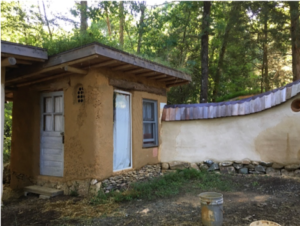 replacing conventional building materials with recycled, or local, or low-chemical options. Rarely is the entire premise of what constitutes a healthy home for the human inhabitants or the Earth considered. Fortunately, there is a growing movementtoward usingnatural building methods and materials that have stood the test of time. They are increasingly being used to address not just the obvious issues of affordability and lack of construction waste, but also increased agency, creativity, health, and well-being.
Two of the most popular building materials are cob and strawbale, and they are often combined for their complementary properties. Cob is a mixture of clay, sand, water, and small amounts of straw, which when dry is covered with a layer of protective clay/lime plaster. It provides good thermal mass so is ideal onsouthern exposure walls and earthen floors. Strawbale construction securely stacks completely dry strawbales then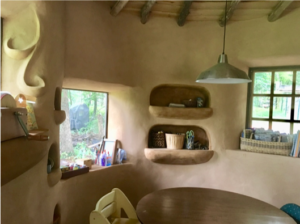 coats them with varying layers of clay plaster, finishing with one of several options for final protection. These coated strawbale walls are much more insulating than conventional materials and are ideal for northern exposure walls. Both materials have endless creative potential for aesthetically pleasing curves and cut-in niches and shelving. And both have a long history in other parts of the world, with many cob structures throughout the British Isles, Africa,and the Middle East in particular. There is a 900-year-old seven-story cob structure still in use in Yemen!
Not only are the structures durable, affordable, and beautiful, but they’re also good for our health. Dani Mouawad, MD, designed and built the first permitted commercial cob structure in North America as part of the Ecoheal campus in Chapel Hill, North Carolina. According to the Ecoheal website, “Clay has a detoxifying effect, is resistant to EMF radiation, and protects the biodiversity of the indoor microbiomes. There is mounting evidence of the correlation between human health and a balanced biodiversity of our intestinal flora. . . .In addition, mold growth is prevented due to the porous quality of cob and the alkaline quality of the lime that lines the walls.” Dr. Mouawadalso sees great potential for the use of off-grid cob buildings with well-designed composting toilets in areas of the world that have large refugee populations in need of inexpensive housing and adequate sanitation,which could be any number of places as climate instability exacerbates political instability.
Greg Allen, who founded theMud Dauber School of Natural Building in Snow Camp, North Carolina, has been a leader in the field. From his initial training with lantoEvans at the Cob Cottage Company in Oregon, who originally brought cob building from his homeland of Wales in the late 60s, until now, Greg has been a huge fan and proponent of this revolutionary way to create housing. His workshops show that with a little leadership and guidance, a group of novices can create very beautiful, very long-lasting, affordable structures. As Greg says on his website, “We celebrate human-power, local building materials (natural and salvaged), and creativity.”
These structures illustrate how communally-built and locally-sourced buildings could become common again. Before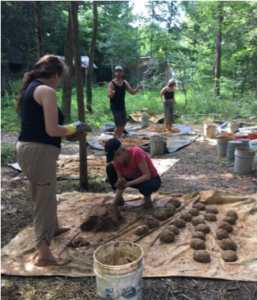 cheap fossil fuels made global transportation of materials the norm, people built houses with the materials that were found essentially on-site—adobe in the desert southwest, wood in forested areas. They often came together as a community to put up abarn or help a new neighbor get established with a house. There are ways to mechanize the cob mixing and building process, but the most common method involves a group of people stomping the ingredients together, then applying them a big handful at a time!
One of the most remarkable qualities of these materials is the feeling you have when you’re in this kind of building, particularly one with a living green roof. There is a kind of peacefulness and quality of the air that is hard to explain. Dani Mouawadof Ecoheal says it’s amazing how often visitors say it just feels good. Even in a space with room for only a twin mattress or a couple of chairs, a different kind of quiet, a different kind of spiritual sense permeates the indoor spaces, renews your spirit,and reconnects you with the natural world.
I recently attended a week-long natural building intensive at the Mud Dauber Schoolthat offered instruction in all facets of natural building. It expanded our exposure to more than cob and strawbale so that we could also have confidence with foundations, living green roofs, composting toilets, wattle and daub (filling in a woven lattice of wood strips with wet clay mix), slipstraw (straw mixed with clay slurry and packed into a form), and harvesting and preparing small trees for use as supports. I slept in a small rustic cottage that had been the building project of a previous workshop. ThoughI arrived tired and acquired many new sore muscles and bug bites, I left feeling refreshed and restored.
The time spent working hard together, learning new possibilities to dramatically reduce the harm done to the natural world for housing needs, and being able to sleep each night essentially surrounded by earth inspired and empowered me to look more creatively at what I and my community might need in terms of shelter. I’m imagining first a new shed with a composting toilet and outdoor shower, then who knows what’s next!